Finding Paid Extension Opportunities with a 7-Day Mid-Market Slice
A public recap of how ExtScope combines paid signals, recent growth, and risk exclusions to find Chrome extension opportunities for indie builders.
Today's slice used a practical discovery lens: mid-sized extensions, recent growth, visible paid signals, and a workflow that an indie builder could narrow into a lighter free version.
This public recap explains the method only. It does not disclose candidate names, extension IDs, competitor links, growth rankings, or directly copyable MVP ideas.
Why Look at 7-Day Mid-Market Growth
Large products often already have distribution, brand, and ecosystem advantages. Very small products can be noisy.
Mid-sized products sit in a useful middle:
- enough users to show real usage
- enough reviews to avoid extremely thin samples
- 7-day growth to catch recent movement
- paid signals to reduce pure monetization guesswork
- product boundaries that may still be narrow enough to attack
These samples are not always poorly rated. The pattern is more specific: people are using the workflow, someone is monetizing it, but the current product may not be the simplest, most trustworthy, or lowest-permission version of the job.
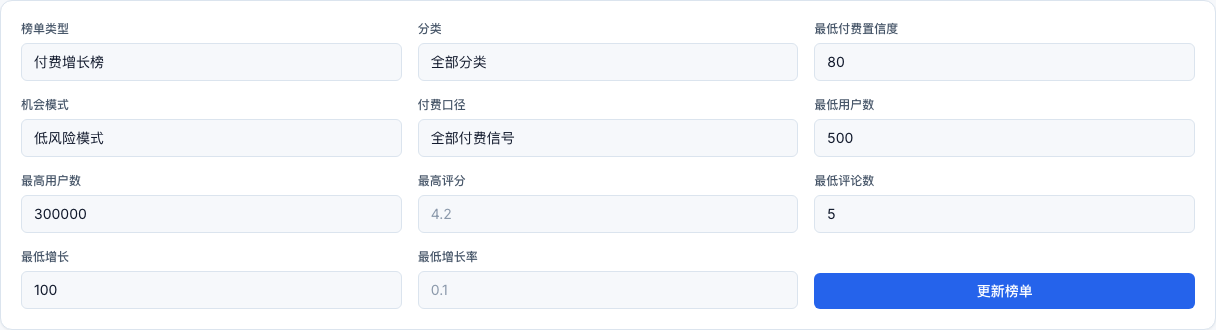
Research Screenshot
The screenshot below comes from the automated research workflow. The public version keeps only the filter method and hides candidate results.
How We Filtered
The internal filter started with hard requirements:
- paid or monetization evidence exists
- paid-signal confidence clears the threshold
- users sit in a mid-market range
- review count is not too thin
- 7-day growth is preferred, with 30-day growth as a fallback
Then we excluded risky directions:
- no download bypass products
- no cookie, password, proxy, or high-trust security tools
- no account automation or bulk social marketing
- no exam, competition, or game-cheating workflows
- no direction that requires users to hand over highly sensitive data
An Anonymous Example
One recurring pattern today was single-site workflow enhancement.
Users may only want to change fonts on one site, organize one AI conversation, adjust audio in one browser tab, block one distraction surface, or translate terms on one game-trading page.
These jobs are small. But because they are frequent enough, paid signals can still appear.
The indie builder opportunity is not to build a larger suite. It is to start with a narrower, more transparent free version:
- current site first
- current tab first
- local processing first
- manual trigger first
- reversible and easy to disable by default
- permission explanations placed where users make decisions
Why This Slice Matters
7-day growth helps surface demand that is moving right now.
30-day growth catches slower but still meaningful demand shifts.
Paid signals show that someone is already trying to monetize the job.
Risk exclusions keep the shortlist practical for indie builders: start with a credible small product instead of stepping directly into platform rules, privacy trust, or copyright boundaries.
The full candidate list, competitor links, and MVP cuts remain internal.