Finding local workflow Chrome extension opportunities from paid signals
A daily paid-extension research recap on shifting from risky growth categories to low-permission, local-first, free-first Chrome extension ideas.
Today’s research again started with confirmed paid signals and recent growth, but the fastest-growing entries were not automatically the best opportunities. After applying stricter filters, several top growth candidates still leaned into ad bypassing, social media downloading, account automation, or other platform-sensitive behaviour. Those can show demand, but they carry higher permission, policy, and maintenance costs than an independent developer should accept for a first replica.
The more useful filter was local workflow fit: a repeated user task, existing paid evidence, and a core feature that can run with a popup, content script, Chrome APIs, and local storage. When the product does not depend on a proprietary backend, the free version can solve one complete action first. Future Pro can then add limits around templates, batch volume, backup/restore, and sync without weakening the base experience.
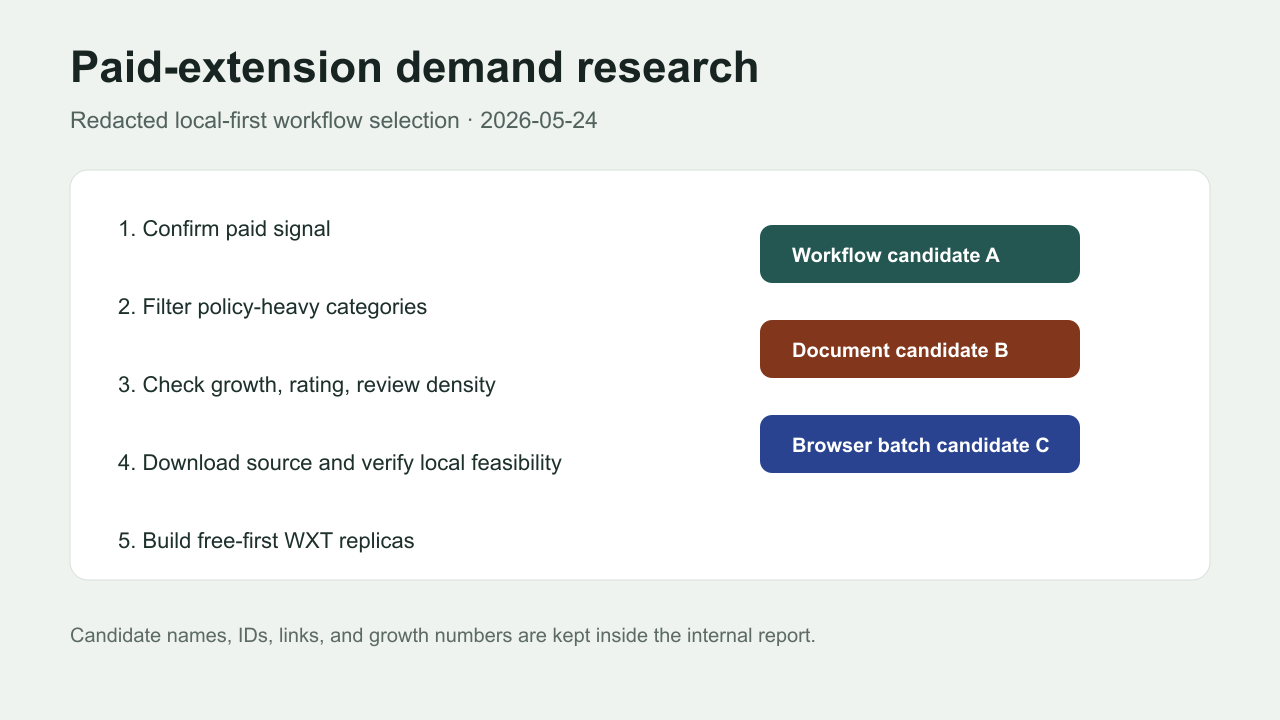
This public recap does not disclose the candidate table, competitor links, extension IDs, growth numbers, or complete MVP details. The internal report keeps the full evidence chain: payment platform, growth lens, rating and review gaps, source download analysis, payment product creation, WXT builds, localization, store assets, and code review.
The repeatable lesson is simple: a free-first counter-position should make one clear task smoother before copying a competitor’s entire feature list. A low-permission extension that works immediately without account pressure can earn more early trust than a broader product that puts core actions behind payment prompts.