Finding Paid Extension Opportunities in Low-Rating Growth Slices
A public recap of how ExtScope combines paid signals, rating ceilings, and 30-day growth to find Chrome extension opportunities that indie builders can attack with narrower products.
Today's slice used a more attack-oriented lens: paid signals are present, the products are still growing, but ratings and reviews already show pressure.
These samples are not necessarily the biggest or newest products. Their value is that demand is still active, while the existing experience has visible gaps around pricing clarity, trust, permissions, reliability, free-plan limits, or broken workflows.
This public recap explains the method only. It does not disclose candidate names, extension IDs, competitor links, or the internal ranked opportunity map.
Why Add a Rating Ceiling
Growth alone often surfaces mature products.
Low ratings alone often surface products users have already abandoned.
This run combined both signals:
- paid or monetization evidence exists
- 30-day user growth is still visible
- users and reviews are not too thin
- rating stays below a chosen ceiling
- reviews reveal repeatable friction
The goal is not to find the worst products. The goal is to find products where users still need the job done, but the current implementation leaves room for a better, narrower alternative.
Research Screenshot
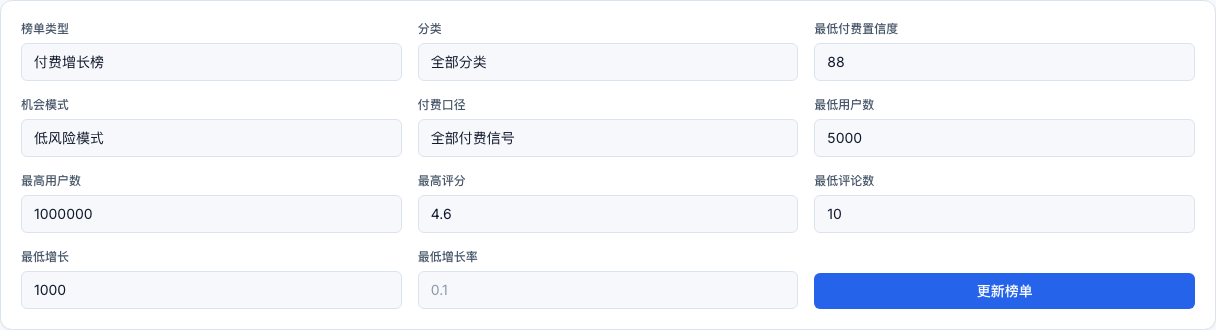
The screenshot below comes from the automated research workflow. The public version keeps only the filter method and hides candidate results.
How We Filtered
The internal filter started with four hard requirements:
- strong enough paid-signal confidence
- enough users, reviews, and 30-day growth
- rating below the ceiling
- no obvious policy-heavy or high-trust risk category
Then we checked review-level gaps:
- features that recently stopped working
- free limits that are too narrow to evaluate the product
- unclear monetization or upgrade expectations
- permission requests that reduce trust
- unstable batch workflows
- weak export, naming, formatting, or recovery behavior
An Anonymous Example
One recurring pattern was lightweight browser workflow enhancement.
Users are not always asking for a large suite. Often they want one action to work reliably: keeping a long page responsive, making a video window easier to use, exporting several pages into stable files, or getting a timely alert when a page changes.
Once a product charges for that workflow, users become less forgiving. The complaints often sound like:
- this should have a useful free baseline
- the paid version is still unreliable
- the permission request feels too broad
- an update broke the old workflow
The indie builder opportunity is not to clone the entire incumbent. It is to build a more trustworthy narrow version:
- local by default
- limited to the current site or tab
- clear permission explanations
- strong recovery and status feedback
- cloud sync, heavy automation, and advanced integrations deferred until later
Why This Slice Matters
Growth shows users are still arriving.
Paid signals show someone is already trying to monetize the job.
Rating pressure shows there is still room for replacement.
When these signals overlap, the opportunity is often more practical for an indie builder: not the largest market, but a small high-frequency workflow where users are already telling the market what feels broken.
The full candidate list, competitor links, and MVP cuts remain internal.