Finding Free-Counter Opportunities in Mid-Sized Paid Extensions
A public recap of how ExtScope combines paid signals, recent demand, review pain, and client-side feasibility to screen Chrome extension opportunities for indie builders.
Today's automated research focused on a category that is especially useful for indie builders: mid-sized Chrome extensions with paid signals, recent demand, and core functionality that can be implemented mostly inside the browser.
This public version explains the method only. It does not publish candidate names, extension IDs, competitor links, ranking details, or directly copyable product plans.
Why Client-Side Feasibility Matters
A paid signal does not automatically mean a good opportunity. Many paid extensions depend on server-side value: AI, account data, cloud sync, anti-bot systems, content parsing, or proxy resources. Trying to counter those for free can quickly become expensive, fragile, or risky.
So this run added a strict product question: can the core workflow be done with content scripts, browser APIs, local storage, and page-level DOM control? When the answer is yes, the opportunity is more realistic for a low-cost, free, trustworthy alternative.
Research Screenshot
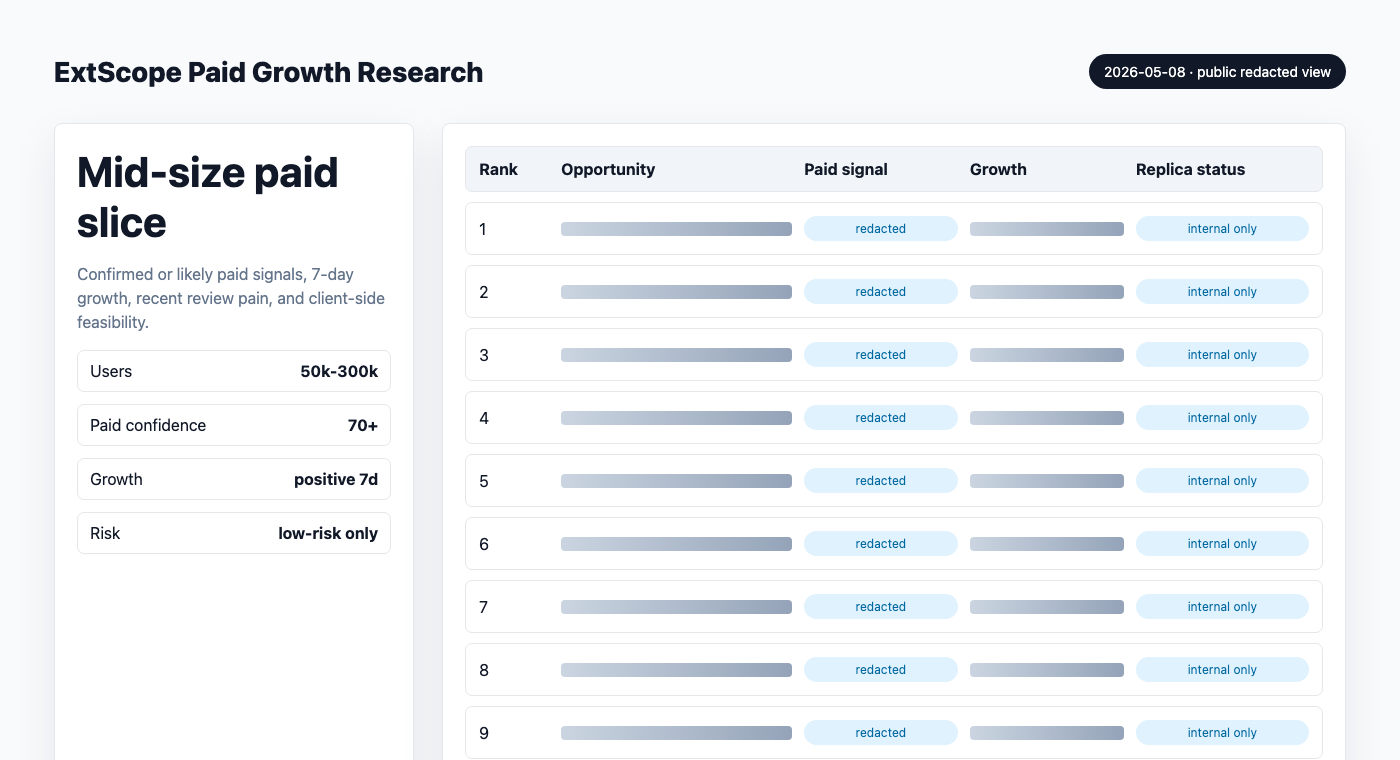
The screenshot below comes from the automated research workflow. The public version only keeps the screening method and redacted workflow proof, not the candidate results.
How We Screened
The internal candidate pool started with:
- Mid-sized user scale
- Clear or high-confidence paid signals
- Recent growth or review activity
- Reviews mentioning stability, pricing, missing capabilities, or UX pain
- Permissions that can be explained clearly
- No obvious server-side dependency for the core workflow
Then we applied a second pass:
- Verify paid-platform signals on the store page and in source files
- Pull recent reviews to confirm demand is still active
- Download extension packages for static analysis
- Decide whether the core workflow can stay inside the browser
- Exclude high-risk categories such as download bypasses, account automation, proxies, exams, and high-trust security tools
An Anonymized Pattern
The strongest pattern today was not “build more features.” It was “make one paid small feature cleaner.”
Many user complaints clustered around a few themes:
- A simple action is locked behind a subscription
- Core behavior breaks after page updates
- Results cannot be previewed or undone
- Popups and ads reduce trust
- Login is required for a task that could be local
- A low-frequency utility asks for recurring payment
That leaves room for a free alternative: narrow the scope, reduce permissions, make the main action reliable, and put preview, recovery, and local processing first.
Product Takeaway
The internal run selected three directions for deeper rebuild validation. They shared several traits:
- Existing users already proved the job exists
- Paid or donation signals showed commercial intent
- Negative reviews clustered around price, breakage, ads, or basic UX
- The core capability could be implemented locally in the extension
- A free version could create a clear contrast
These opportunities do not need to start as platforms. A more realistic entry is a focused utility that is understandable, recoverable, account-free, and ad-free.
The full candidate list, competitor links, source analysis, and concrete rebuild plans remain internal.