Using 7-day growth to evaluate paid Chrome extension opportunities
This public recap explains how 7-day growth helps evaluate paid Chrome extension opportunities without publishing the full demand list or competitor set.
A static paid signal can show that users are willing to pay. It does not always show that demand is heating up right now.
So this run added a more dynamic metric:
7-day growth.
This public version explains how to use that metric. It does not publish the full growth list, multiple demand points, or a competitor-link collection.
Research screenshots
The screenshots below come from this automated research run. Candidate names, growth numbers, and competitor cards are redacted in the public version; the images are included only to show the workflow.
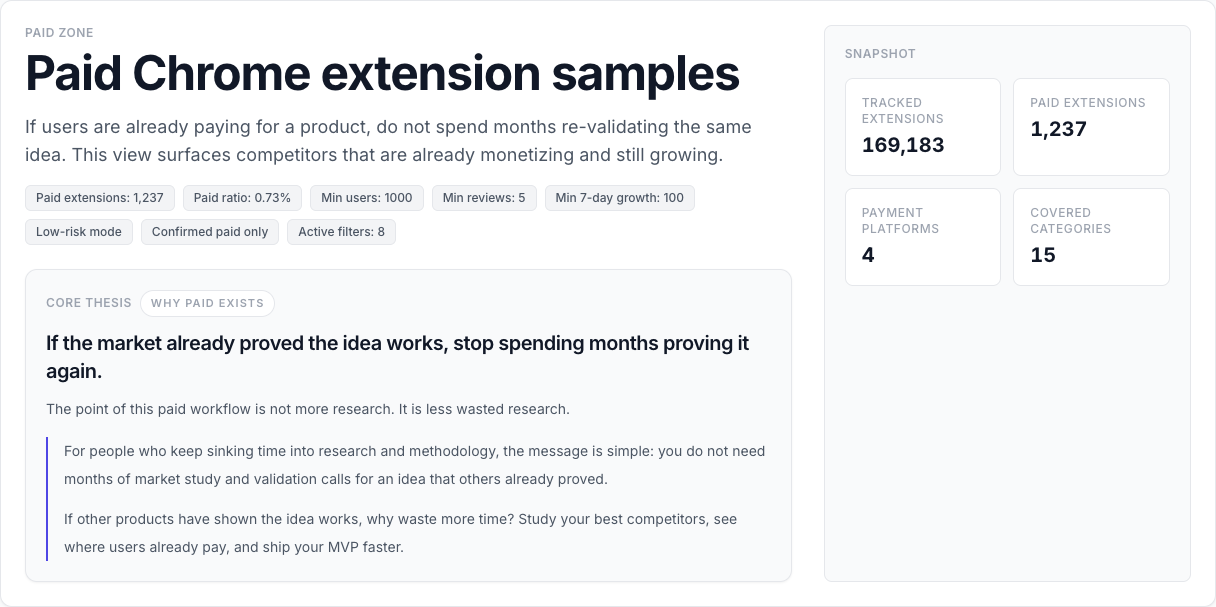
Step 1: Start from a pool where paid signals and recent 7-day growth are both present, instead of guessing from keywords.
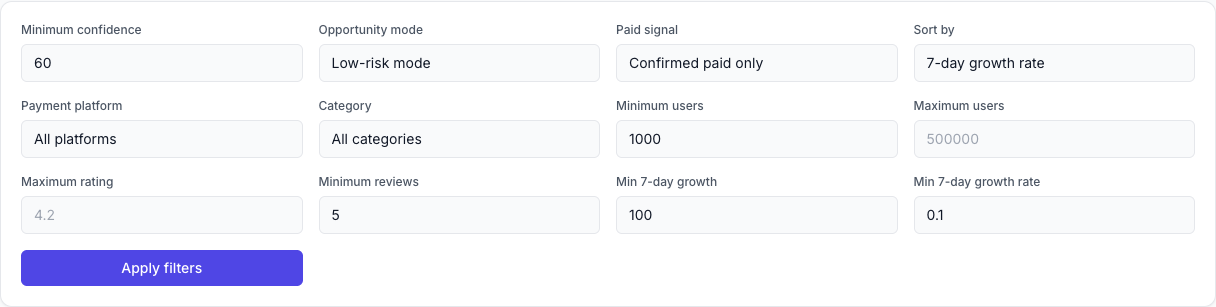
Step 2: Use paid confidence, user count, review count, 7-day growth, and low-risk mode to narrow the candidate set.
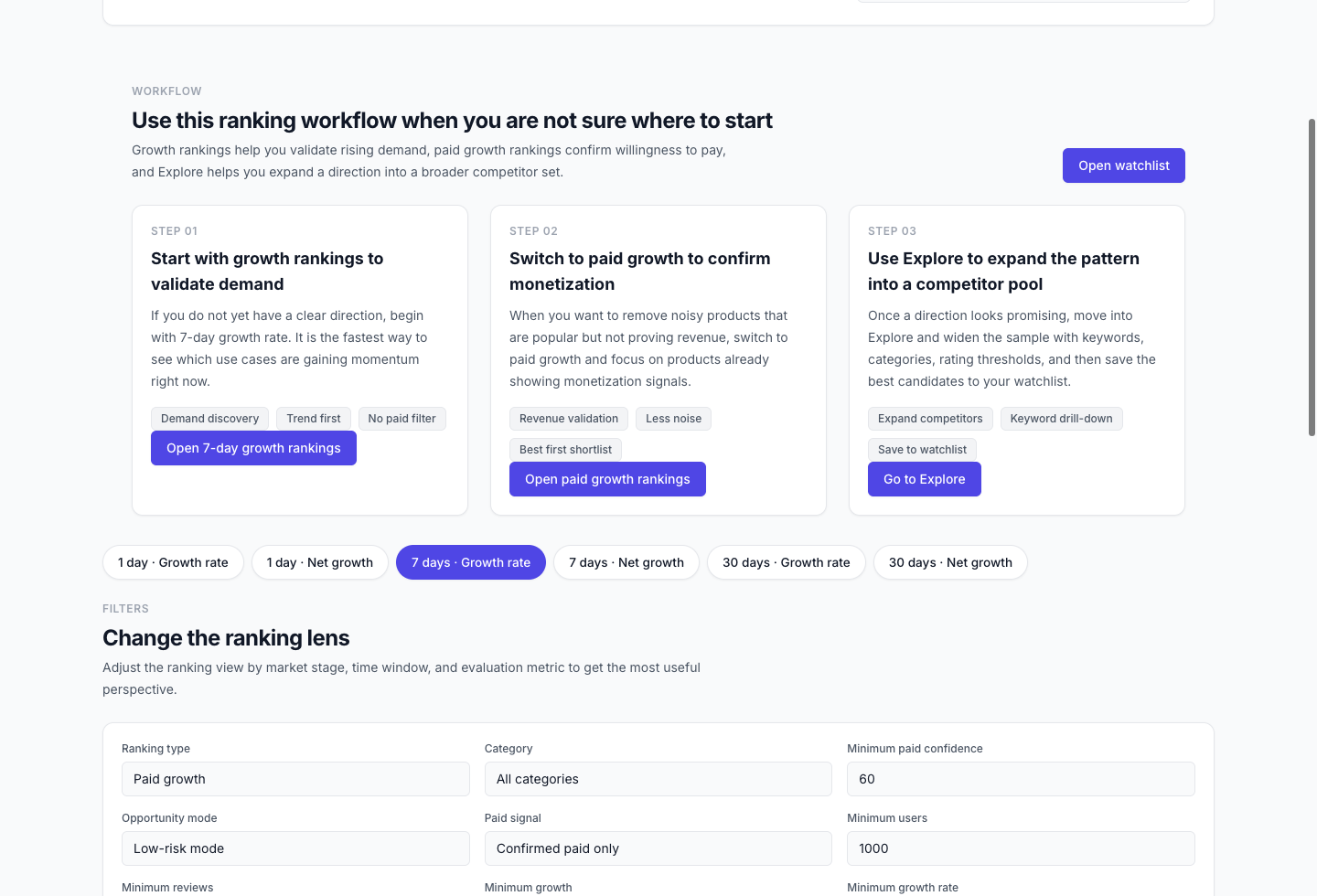
Step 3: Cross-check the slice in paid growth rankings without publishing candidate names or itemized growth positions.
Why 7-day growth matters
Seven-day growth can reveal:
- A small utility that is suddenly being discovered
- A workflow category that is gaining momentum
- A paid product whose commercial signal may be forming
But growth is a clue, not a conclusion. It still needs to be checked against paid signals, reviews, ratings, permissions, and platform risk.
How we tier the data
Internally, we split candidates into two levels:
- Confirmed paid growth: clearer paid status and payment-platform evidence
- Broad paid growth: richer growth signal, but requires secondary commercial verification
These tiers should not be mixed. Otherwise, readers may assume every growing sample is fully confirmed.
One anonymized example
One sample showed clear 7-day growth around a narrow repetitive task.
It was worth internal follow-up because the signal mix was strong:
- Fast recent growth
- Easy-to-understand outcome
- Reviews showed both strong utility and basic reliability gaps
- A free version could focus on making one action dependable
That is enough for a public example. Publishing the exact name and link would give away the opportunity itself.
Interpreting growth carefully
Chrome Web Store user counts often appear in rounded buckets, so growth can show up as steps such as +1,000 or +10,000.
That means:
- Large products are better judged by absolute growth
- Small products are better judged by growth rate
- Strong growth still needs risk filtering
- Account-security, sensitive-permission, and gray-area products should be separated
The public boundary
Public posts can share:
- Why 7-day growth is useful
- How to separate confirmed paid from suspected paid
- How to avoid being misled by risky growth
- How growth becomes an internal validation queue
Public posts should not share:
- Multiple specific opportunity names
- Competitor-link collections
- Itemized growth rankings
- Directly copyable MVP entry points
Takeaway
Seven-day growth is useful for spotting emerging opportunities, but the public story should stay methodological.
The opportunity list remains internal.