Finding paid extension ideas with rating pressure and 30-day growth
A public recap of how ExtScope combines paid signals, 30-day growth, and rating pressure to identify Chrome extension opportunities without exposing the internal candidate list.
Yesterday's workflow focused on mid-sized extensions with strong recent growth.
Today we used a different lens: rating pressure, 30-day growth, and paid signals.
This slice is useful when you want to find opportunities where users are still arriving, but the incumbent may be leaving room through dated UX, heavy permissions, fragile workflows, or an overbuilt product surface.
This public version explains the method only. It does not disclose candidate names, extension IDs, competitor links, or item-level growth rankings.
Why 30-day growth matters
Seven-day growth is good for spotting bursts.
Thirty-day growth is better for asking whether demand is still flowing into a category.
When a monetized extension is still growing over 30 days and also shows rating pressure or permission concerns, it is worth asking:
- Why are users still installing it?
- Do they only need one narrow action?
- Could a free product solve that action with lower permissions?
- Has the incumbent become more complex than the first-time user needs?
Workflow Screenshot
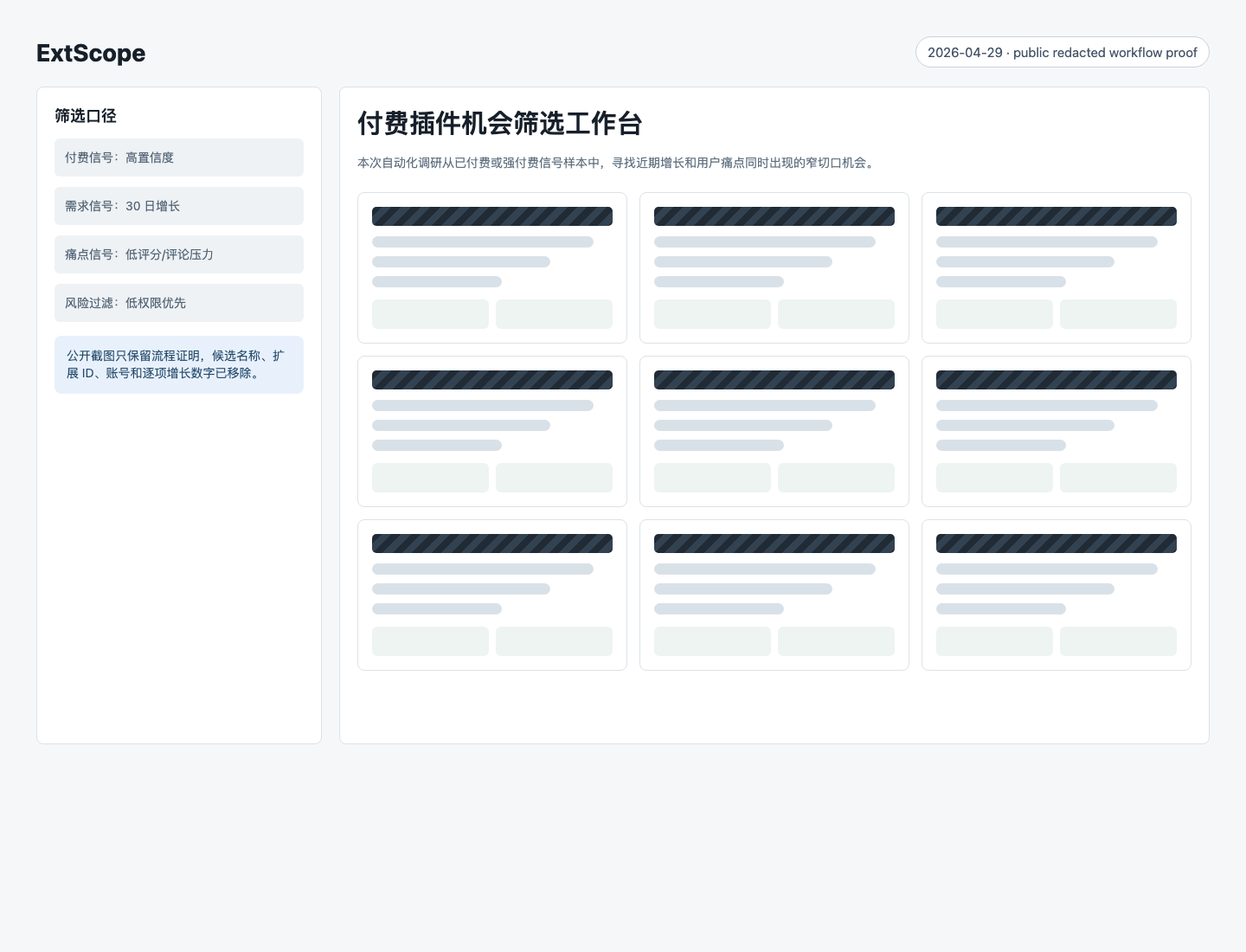
The screenshot below comes from this automation run. Candidate cards, account details, extension IDs, and item-level growth numbers have been removed.
How We Filtered
The internal filter started with four requirements:
- A high-confidence paid or commercialization signal
- Enough users and reviews to avoid thin samples
- Visible 30-day user growth
- Rating, permission, or product-copy evidence of a gap
Then we applied risk filters:
- Samples that read sensitive browsing data were downgraded
- Products that depend on accounts, sessions, or cookies were downgraded
- Ad blocking, proxying, download bypasses, and account automation were not prioritized
- Local-first, low-permission, narrow tools were preferred
One Anonymized Example
One candidate in the workflow is a web annotation tool with meaningful user count, visible 30-day growth, and a rating below the level we would expect from a polished utility.
The opportunity is not to clone the whole product. A more practical free wedge would be:
- Read the current tab only after user action
- Provide screenshot markup, sensitive-area blur, and export
- Avoid uploading page content by default
- Make undo, failure states, and export behavior clearer
Rating pressure is not just a negative signal. It can also mean the demand is real, but the smallest job has not been made reliable enough.
Why This Slice Works
Paid signals show that someone has already tried to monetize the workflow.
Thirty-day growth shows that demand is still active.
Rating pressure reminds us not to stop at install count. It points to friction around complexity, permissions, reliability, or expectation setting.
For an independent developer, the best opportunity is often not the biggest product. It is one repeated action made clearer, safer, and easier to trust.
The full candidate list, competitor links, and concrete MVP wedges remain internal.