Finding Paid Extension Opportunities in Permission-Heavy Growth Slices
A public recap of how ExtScope combines paid signals, 30-day growth, and permission pressure to find Chrome extension opportunities for indie builders.
Today's slice used a trust-oriented lens: paid signals are present, 30-day growth is visible, but the existing products carry heavier permissions, broad host access, or oversized product boundaries.
These samples are not always poorly rated. Some are growing and well reviewed. The opportunity comes from another gap: the user job is narrow, while the incumbent has expanded into more sites, more permissions, more account state, or more cloud features than a first-time user may want.
This public recap explains the method only. It does not disclose candidate names, extension IDs, competitor links, or the internal ranked opportunity map.
Why Look at Permission Pressure
Many Chrome extension opportunities are not only about features. They are about trust.
Once a product starts charging, users inspect questions like:
- Why does it need access to every website?
- Does it touch chats, clipboard content, learning history, or browsing data?
- If I only need one small workflow, why do I need an account or sync?
- Can the free version prove the core action works before I upgrade?
So this run combined growth and permission pressure:
- paid or monetization evidence exists
- 30-day user growth is visible
- users and reviews are not too thin
- permissions, host coverage, or product scope feel heavier than the job
- the task can be narrowed into a credible free MVP
Research Screenshot
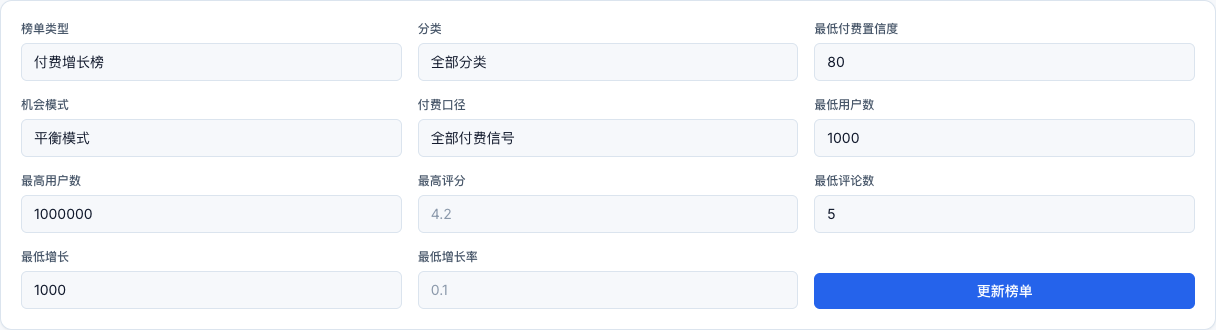
The screenshot below comes from the automated research workflow. The public version keeps only the filter method and hides candidate results.
How We Filtered
The internal filter started with four hard requirements:
- strong enough paid-signal confidence
- enough 30-day growth
- enough users and reviews to avoid thin samples
- no obvious policy-heavy or high-trust risk category
Then we checked permission and product boundaries:
- broad all-site access or many host patterns
- clipboard, chat, cookie, browsing history, or page-content exposure
- multi-platform scope that may be too broad for the first use case
- whether the workflow can be current-tab, current-site, or manually triggered
- whether clearer permission copy could reduce new-user friction
An Anonymous Example
One recurring pattern was narrow browser workflow enhancement.
Users may only want to move live chat into a clean overlay, translate the current page, copy a formula into an assignment, or find one answer from last week's AI conversation.
Those jobs are small. But incumbents often grow into multi-platform, multi-permission, account-based, sync-heavy suites.
The indie builder opportunity is not to clone the whole product. It is to build a more trustworthy narrow version:
- local by default
- limited to the current site or current tab
- permission explanations in the install and empty states
- strong failure, undo, and recovery behavior
- cloud sync, heavy automation, and multi-platform aggregation deferred
Why This Slice Matters
Growth shows users are still arriving.
Paid signals show someone is already trying to monetize the job.
Permission pressure shows users may switch to a lighter, more transparent alternative.
When these signals overlap, the opportunity is often more practical for an indie builder: not a larger suite, but a small high-frequency workflow that feels safer from the first install.
The full candidate list, competitor links, and MVP cuts remain internal.