Using Search Gaps to Find Paid Extension Opportunities
A public recap of how ExtScope combines paid signals, 7-day growth, recent reviews, and core keyword crowding to find Chrome extension opportunities for indie builders.
Today's automated research run did not only look for mid-sized products with review pain. It added a more product-oriented lens: whether the core search term is already crowded by mature competitors.
This public version explains the method only. It does not publish candidate names, extension IDs, competitor links, ranking details, or directly copyable MVP plans.
Why Search Gaps Matter
Growth and paid signals tell us that people use a workflow and that similar capability may have commercial intent. For an indie builder, another question matters just as much: when users search for the job, are the top results already locked up?
This run required several signals to appear together:
- Strong paid evidence
- 7-day growth or recent reviews showing live demand
- User scale that is not too thin
- A core job that can be expressed as one search query
- Top search results that leave some room for a narrower product
- Permissions and site scope that can be explained clearly
That combination is useful because it points to small, specific entry points. The opportunity is not to build a full suite first. It is to make one repeated action stable and trustworthy.
Research Screenshot
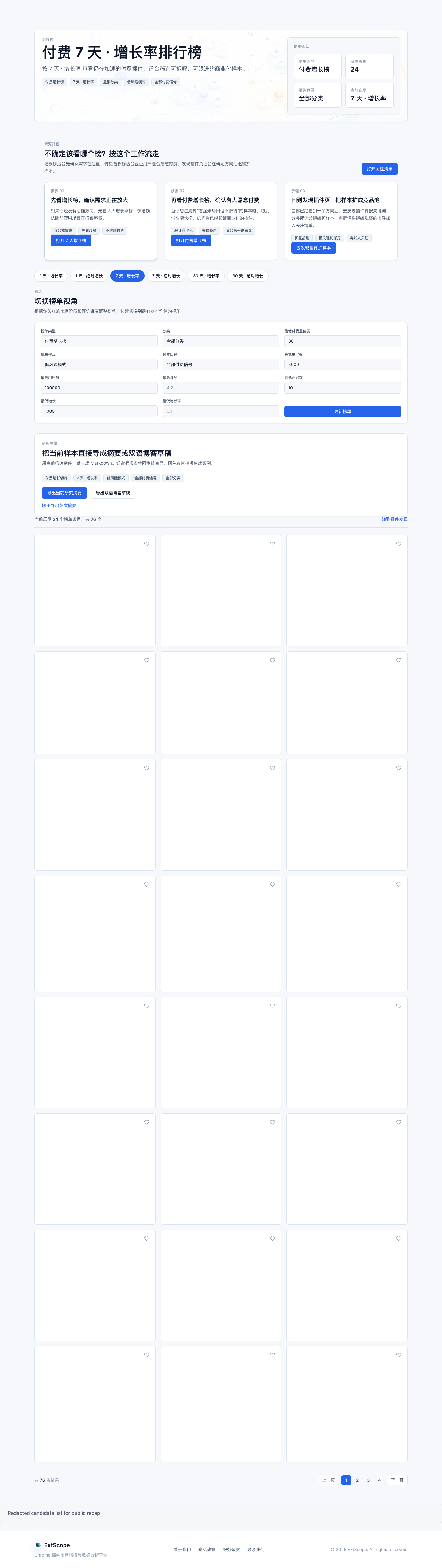
The screenshot below comes from the automated research workflow. The public version only keeps the screening method and redacted workflow proof, not the candidate results.
How We Screened
The internal candidate pool started with:
- Small to mid-sized user scale
- Paid-confidence threshold
- Minimum 7-day growth
- Enough reviews to reason from
- Exclusion of samples already covered in prior internal reports
Then we applied a second pass:
- Verify paid platforms and paid copy in real time
- Pull recent reviews to confirm demand is still active
- Search the core job phrase to estimate crowding
- Exclude download bypasses, account automation, password or cookie tools, proxies, exams, bulk social-media workflows, and high-trust security products
An Anonymized Pattern
The strongest pattern today was simple: users may pay for a small workflow, but they do not want to buy a heavy suite when they only need one reliable action.
Several reviews were not asking for more features. They were asking for the basics to hold:
- Long content should export completely
- Core behavior should survive site updates
- Settings and modes should not disappear
- Failures should be visible
- Results should be verifiable and recoverable
- Login should not be required when the job can stay local
The free-counter position is usually to narrow the scope, reduce permissions, and give users preview, undo, and recovery.
Why This Slice Is Useful
Search gaps make growth rankings closer to product decisions.
A direction needs more than growth and paid intent. It also needs a clear entry point where a lighter product can be discovered and chosen.
The full candidate list, competitor links, and concrete entry plans remain internal.