Finding Paid Chrome Extension Ideas That Can Be Rebuilt Client-Side
A public recap of how we combine paid signals, user scale, ratings, and source-code feasibility to find Chrome extension opportunities for indie developers.
Today’s automated research focused on paid Chrome extensions, but the main filter was narrower than growth alone: can the core job be rebuilt with browser-side capabilities?
This public recap explains the method only. It does not disclose candidate names, extension IDs, competitor links, exact growth rows, or replica plans.
Why Client-Side Feasibility Matters
Many paid extensions look attractive until you inspect the core dependency. Some products rely on AI services, proxy infrastructure, account data, cloud sync, search-volume databases, or brittle scraping systems. Rebuilding those as an indie developer is expensive and risky.
The better wedge is a paid product where users have proven demand, but the main action can be handled with content scripts, Chrome APIs, local storage, and page-level UI.
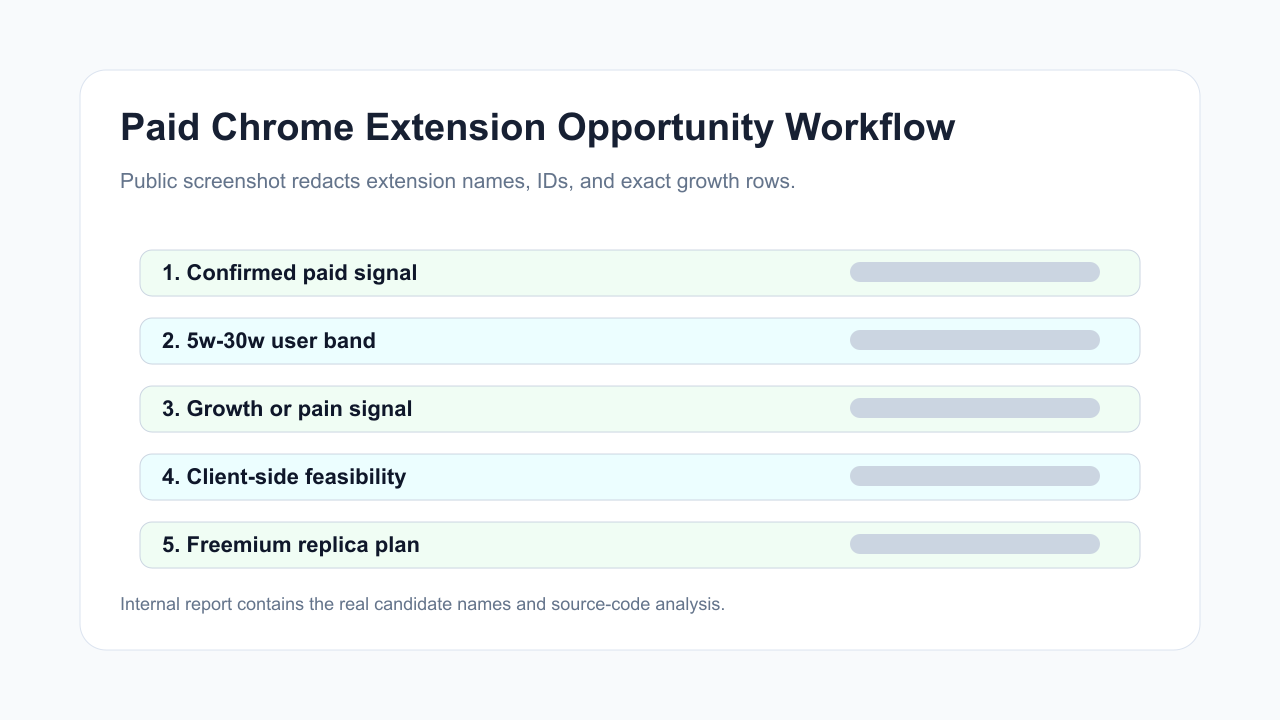
The Research Lens
The internal candidate pool looked for:
- Mid-sized install base
- Clear or high-confidence paid signals
- Growth, weak ratings, high review volume, or repeated workflow pain
- Permissions that can be explained clearly
- No account-reward automation, download bypassing, VPN/proxy dependence, exam cheating, or high-trust security surface
After that, we downloaded extension packages and inspected the source to separate payment logic from the actual user-facing job.
An Anonymized Takeaway
The strongest pattern was not “build a bigger product.” It was “make a small paid workflow cleaner and freer.”
Common gaps included:
- Simple jobs hidden behind subscriptions
- Login requirements where local execution would be enough
- Export, sync, or higher limits reserved for paid users
- Low ratings around broken selectors, ads, complex settings, or trust issues
- Users who just want a small reliable utility
The practical playbook is to launch free, keep permissions tight, make the core action stable, and reserve cloud sync, bulk work, advanced rules, or enriched data for later paid upgrades.
The full candidate list and source-code analysis remain internal.